

SWOT analysis: What it is and how to use it (with examples)

- SWOT (an acronym for “strengths, weaknesses, opportunities, and threats”) analysis is a strategic planning tool that gives you insight into the current state of your business or a specific project in context of internal as well as market and customer conditions.
- A SWOT analysis helps you to identify strengths, weaknesses, opportunities and threats of a company or a specific project.
- The primary objective of a SWOT analysis is to help organizations develop a full awareness of all the factors involved in making a business decision.
- Perform a SWOT analysis before you commit to any sort of company action, whether you are exploring new initiatives, changing internal policies, considering opportunities to change a plan midway through its execution.
What is a SWOT analysis?
History-
Albert Humphrey of the Stanford Research Institute created this method in the 1960s during a study conducted to identify why corporate planning consistently failed. Since its creation, the SWOT analysis has become one of the most useful tools for business owners to start and grow their companies.
“It is impossible to accurately map out a start-up business’s future without first evaluating it from all angles, which includes an exhaustive look at all internal and external resources and threats,” Bonnie Taylor, chief marketing officer at CCS Innovations, told Business News Daily. “A SWOT accomplishes this in four straightforward steps that even rookie business owners can understand and embrace.”
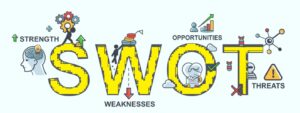
- Strengths: What are you good at & What are your experiences level? What are the unique skill sets put you at an advantage? What do others (e.g., customers, partners, vendors, competition, etc.) think you’re good at?
- Weaknesses: What are your weaknesses? Where do your competitors have an edge?
- Opportunities: What trends, business, or market opportunities could you exploit to positively impact you and your business? Is there any geographic opportunity? A more affordable vendor or latest market trend changing the consumers behavior.
- Threats: What are your competitors doing that could endanger or damage your business? What requires your immediate attention? For example, do you have enough finances? Are you using old technology which will obsolete in next few months.
When should you perform a SWOT analysis?
Do a SWOT analysis before you commit to any company action, whether that’s exploring new initiatives, revamping internal policies, considering opportunities to pivot or altering a plan midway through its execution. Sometimes it’s wise to perform a general SWOT analysis to check on the current state of your business and improve operations as needed. The analysis can show you key areas where your organization is performing optimally and areas where operations need improvement.
If you take the time to put together a formal SWOT analysis, you’ll be able to see the whole picture of your business or your new project. From there, you can identify ways to improve or eliminate your company’s weaknesses and capitalize on its strengths.
While the business owner should certainly be involved in creating a SWOT analysis, it is often helpful to include other team members in the process. Ask for input from a variety of team members and openly discuss any contributions made. The collective knowledge of the team will allow you to adequately analyze your business from all sides.
What are the characteristics of a SWOT analysis?
A SWOT analysis focuses on the four elements of the acronym, allowing companies to identify the forces influencing a strategy, action or initiative. Knowing these positive and negative elements can help companies more effectively communicate what parts of a plan need to be recognized.
When drafting a SWOT analysis, individuals typically create a table split into four columns to list each impacting element side by side for comparison. Strengths and weaknesses won’t typically match listed opportunities and threats verbatim, although they should correlate, since they are tied together.
Billy Bauer, owner of ROYCE New York, noted that pairing external threats with internal weaknesses can highlight the most serious issues a company faces.
“Once you’ve identified your risks, you can then decide whether it is most appropriate to eliminate the internal weakness by assigning company resources to fix the problems, or to reduce the external threat by abandoning the threatened area of business and meeting it after strengthening your business,” said Bauer.
Internal factors
Strengths (S) and weaknesses (W) refer to internal factors, which are the resources and experience readily available to you.
These are some common internal factors:
- Core competencies, skills, talents, expertise, and experience
- Product portfolio and pipeline development
- Point of difference, i.e., what’s your competitive advantage? What sets you apart from the competition?
- Proprietary information, patents, and trademarks
- Value, price, utility, quality, geographic advantages
- Key assets in the form of human resources, technology, research and development, or financials
- Accreditations, awards, testimonials, and brand or science-backed research
- Sales and marketing prowess
- Customer service, care, and management
- Operational and systems efficiency/efficacy
- Vision, mission, beliefs, and value system
- Company culture, organizational structure, and management
External factors
External factors are typically things you or your company do not control, such as the following:
- Social, economic (macro and micro), and political climate
- Pricing regulations or market-driven pricing
- Government or industry rules and regulations
- Points of supply and distribution
- Market and product trends and innovations
- Customer trends and behavior
- Technological shifts and advancements
- Competitor business and brand practices, advantages, and disadvantages
After you create your SWOT framework and fill out your SWOT analysis, you will need to come up with some recommendations and strategies based on the results & business decisions.
Key Takeaways
In a SWOT analysis, strengths and weaknesses cover your own resources and processes. Opportunities and threats pertain to conditions outside your organization, such as market trends and regulations.
The SWOT analysis is a simple but comprehensive strategy for identifying not only the weaknesses and threats of an action plan, but also the strengths and opportunities it makes possible. However, a SWOT analysis is just one tool in your business strategy. Additional analytic tools to consider include the PESTLE analysis(political, economic, social and technological, legal, environmental), MOST analysis (mission, objective, strategies and tactics) and SCRS analysis (strategy, current state, requirements and solution).
Consistent business analysis and strategic planning is the best way to keep track of growth, strengths and weaknesses. Use a series of analysis strategies, like SWOT, in your decision-making process to examine and execute strategies in a more balanced, in-depth way.
PESTLE analysis
A PESTLE (an acronym for “political, economic, sociocultural, technological, Legal, Environmental”) analysis observes how and which external factors could impact your business within a given timeframe. These are environmental elements that could either impede growth or serve as strategic opportunities. PESTLE analysis helps you gauge the health and growth potential of a particular industry and contextualize how your company could be primed for growth or decline. Consider PEST a perfect pregame exercise for your SWOT analysis.
How to start your SWOT analysis
Now that you have a detailed insight into the internal and external elements affecting your business, you can now prepare a draft SWOT. Keep it simple, short & with specific list of essentials.
Once you create a working draft of your SWOT, you want to layer in supportive data, the elements that validate or debunk your story. Your internal data sources could include macro figures, such as sales, gross margin, net revenue (or income), total cash on hand (i.e., liquidity), assets, and liabilities. Your micro data sources could include website traffic and conversions, newsletter sign-ups and CTR (click-through rate), PPC (pay-per-click), display and retargeting ad performance, customer churn rate, CRM (customer relationship management), and customer care performance—the list is endless. You can also factor in any proprietary primary research you’ve conducted on the market and/or your customers.
In terms of external data sources, an extraordinary amount of online tools can help you evaluate competitor public data, including social media, SEM, and digital strategy and performance. If the company is public, you can view shareholder reports, stock prices, and quarterly/annual earnings calls and reports. Companies often work with third-party agencies to assess competitor traditional PR campaigns and media buys.
You also have access to a treasure trove of secondary research that can give you vital information about your customer and market. I like to think of external analysis in concentric circles. On the outermost layer are macro industry and consumer trends, and closer to the center are segments and subsegments of the macro insights and trends.
Case Studies-
For example, let’s say you are planning to start an e-commerce Nursery start up.
Market data is telling you that consumers are increasingly abandoning going to the market for shopping the plants due to COVID-19, time scarcity & different options available online.
Macro consumer trends show that people are busier than ever, they don’t have time to go to the market to purchase the plants,flowers & also due to COVID-19 consumers avoid to go outside ,. If you want to dig deeper, you might examine your demographic and psychographic differences and nuances, as well as what direct competitors are doing to combat the trend and whether they’ve been successful. You went from a broad understanding of competitor and customer trends and narrowed it down. Maybe you noticed one of your direct competitors offering delivery via Amazon or Flipkart to create various attractive options that align with their customer’s behavioral shift.
See the image below for SWOT analysis-


temp mail
April 10, 2025Your blog has become my go-to source for inspiration and motivation Thank you for consistently delivering high-quality content